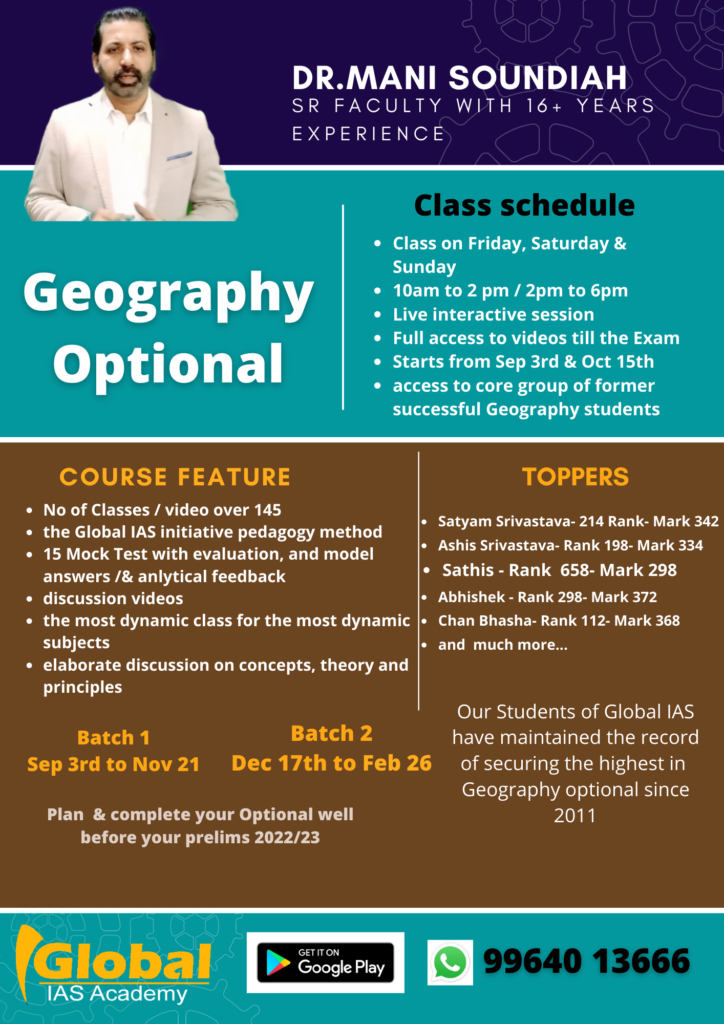
How to Prepare for Geography Optional | global ias academy
IAS Study Image

Principles of Geography

Topic Description
Geomorphology Factors controlling landform development, endogenetic and exogenetic forces, origin and evolution of the earth’s crust, geomagnetism, plate tectonics, earthquakes, and tsunamis.
Climatology Temperature and pressure belts, heat budget of the earth, atmospheric circulation, planetary and local winds, monsoons, and global climatic change.
Oceanography Bottom topography of the Atlantic, Indian, and Pacific Oceans, ocean currents, marine resources, coral reefs, and marine pollution.
Biogeography Genesis of soils, classification of soils, soil erosion, world distribution of plants and animals, social forestry, wildlife conservation.
Environmental Geography Ecological principles, environmental degradation, conservation strategies, sustainable development, and environmental impact assessment.

Paper – 1

Principles of Geography

Physical Geography

Principles of Geography

Geomorphology: Factors controlling landform development, endogenetic and exogenetic forces, origin and evolution of the earth’s crust, geomagnetism, plate tectonics, earthquakes, and tsunamis.

Climatology: Temperature and pressure belts, heat budget of the earth, atmospheric circulation, planetary and local winds, monsoons, and global climatic change.

Oceanography: Bottom topography of the Atlantic, Indian, and Pacific Oceans, ocean currents, marine resources, coral reefs, and marine pollution.

Biogeography: Genesis of soils, classification of soils, soil erosion, world distribution of plants and animals, social forestry, wildlife conservation.

Environmental Geography: Ecological principles, environmental degradation, conservation strategies, sustainable development, and environmental impact assessment.

IAS Study Image

Global IAS Academy

Choose Your Optional

Human Geography

1. Perspectives in Human Geography

Areal differentiation; regional synthesis; Dichotomy and dualism; Environmentalism; Quantitative revolution and locational analysis; radical, behavioural, human and welfare approaches; Languages, religions and secularisation; Cultural regions of the world; Human development index.

2. Economic Geography

World economic development: measurement and problems; World resources and their distribution; Energy crisis; the limits to growth; World agriculture: typology of agricultural regions; agricultural inputs and productivity; Food and nutrition problems; Food security; famine: causes, effects and remedies; World industries: locational patterns and problems; patterns of world trade.

3. Population and Settlement Geography

Growth and distribution of world population; demographic attributes; Causes and consequences of migration; concepts of over-under-and optimum population; Population theories, world population problems and policies; Social well-being and quality of life; Population as social capital. Types and patterns of rural settlements; Environmental issues in rural settlements; Hierarchy of urban settlements; Urban morphology: Concepts of primate city and rank-size rule; Functional classification of towns; Sphere of urban influence; Rural – urban fringe; Satellite towns; Problems and remedies of urbanization; Sustainable development of cities.

4. Regional Planning

Concept of a region; Types of regions and methods of regionalisation; Growth centres and growth poles; Regional imbalances; regional development strategies; environmental issues in regional planning; Planning for sustainable development.

5. Models, Theories and Laws in Human Geography

Systems analysis in Human geography; Malthusian, Marxian and demographic transition models; Central Place theories of Christaller and Losch;Perroux and Boudeville; Von Thunen’s model of agricultural location; Weber’s model of industrial location; Ostov’s model of stages of growth. Heartland and Rimland theories; Laws of international boundaries and frontiers.

Paper - 2

Geography of India

1. Physical Setting:

Space relationship of India with neighboring countries; Structure and relief; Drainage system and watersheds; Physiographic regions; Mechanism of Indian monsoons and rainfall patterns; Tropical cyclones and western disturbances; Floods and droughts; Climatic regions; Natural vegetation; Soil types and their distributions.

2. Resources:

Land, surface and ground water, energy, minerals, biotic and marine resources; Forest and wildlife resources and their conservation; Energy crisis.

3. Agriculture:

Infrastructure: irrigation, seeds, fertilizers, power. Institutional factors: land holdings, land tenure and land reforms; Cropping pattern, agricultural productivity, agricultural intensity, crop combination, land capability.

4. Industry

Evolution of industries; Locational factors of cotton, jute, textile, iron and steel, aluminium, fertilizer, paper, chemical and pharmaceutical, automobile, cottage and agro – based industries; Industrial houses and complexes including public sector undertakings; Industrial regionalisation; New industrial policies; Multinationals and liberalization; Special Economic Zones; Tourism including eco-tourism.

5. Transport, Communication and Trade

Road, railway, waterway, airway and pipeline networks and their complementary roles in regional development; Growing importance of ports on national and foreign trade; Trade balance; Trade Policy; Export processing zones; Developments in communication and information technology and their impacts on economy and society; Indian space programme.

6. Cultural Setting

Historical Perspective of Indian Society; Racial, linguistic and ethnic diversities; religious minorities; major tribes, tribal areas and their problems; cultural regions; Growth, distribution and density of population; Demographic attributes: sex-ratio, age structure, literacy rate, work-force, dependency ratio, longevity; migration (inter-regional, intra-regional and international) and associated problems; Population problems and policies; Health indicators.

7. Settlements

Types, patterns and morphology of rural settlements; Urban developments; Morphology of Indian cities; Functional classification of Indian cities; Conurbations and metropolitan regions; urban sprawl; Slums and associated problems; town planning; Problems of urbanization and remedies.

8. Regional Development and Planning

Experience of regional planning in India; Five Year Plans; Integrated rural development programmes; Panchayati Raj and decentralised planning; Command area development; Watershed management; Planning for backward area, desert, drought prone, hill, tribal area development; multi-level planning; Regional planning and development of island territories.

9. Political Aspects

Geographical basis of Indian federalism; State reorganisation; Emergence of new states; Regional consciousness and inter-state issues; international boundary of India and related issues; Cross border terrorism; India’s role in world affairs; Geopolitics of South Asia and Indian Ocean realm.

10. Contemporary Issues: Ecological issues

Environmental hazards: landslides, earthquakes, Tsunamis, floods and droughts, epidemics; Issues relating to environmental pollution; Changes in patterns of land use; Principles of environmental impact assessment and environmental management; Population explosion and food security; Environmental degradation; Deforestation, desertification and soil erosion; Problems of agrarian and industrial unrest; Regional disparities in economic development; Concept of sustainable growth and development; Environmental awareness; Linkage of rivers; Globalisation and Indian economy.

Note : Candidates will be required to answer one compulsory map question pertinent to subjects covered by this paper.

PROS & CONS OF CHOOSING GEOGRAPHY OPTIONAL

Geography is one of the most popular optional subjects in the UPSC civil services exam. Many toppers have chosen this subject over the years, such as Ira Singhal (2015) and Saumya Pandey (2016). While some aspirants swear by Geography, others find it challenging. This article outlines the pros and cons of selecting Geography as an optional subject.

Choosing an optional subject for the UPSC mains exam is a personal decision. Candidates must weigh the strengths and weaknesses of a subject to determine whether it suits their background and interests.

Pros of Geography Optional

  • Geography is a scientific subject with a logical structure, making it easier to understand.
  • There is not much mugging up required. Only concepts need to be understood.
  • There is no dearth of material available for Geography.
  • It has tremendous overlap with General Studies both in prelims and the mains.
  • With the questions becoming more dynamic and less static, Geography also has a lot of overlap with subjects like economics, environment, ecology and conservation.
  • Candidates can also use what they learn in Geography in their essay paper on various topics.
  • Even in the UPSC personality test, Geography will be useful as the board can ask questions on the local geography of a candidate’s home town like soil, vegetation, minerals, etc.
  • Geography is a scoring subject because unlike humanities subjects, there is not much scope for interpretation. Also, diagrams, flowchart, etc. can be used to get more marks.
  • The map-based questions are also scoring.

Cons of Geography Optional

  • The biggest negative about Geography is that it has a rather LOOKS huge syllabus but it overlaps with GS syllabus
  • The competition in this optional subject is immense when compared to some other subjects.